Northwestern
Lab for Internet and Security Technology (LIST)
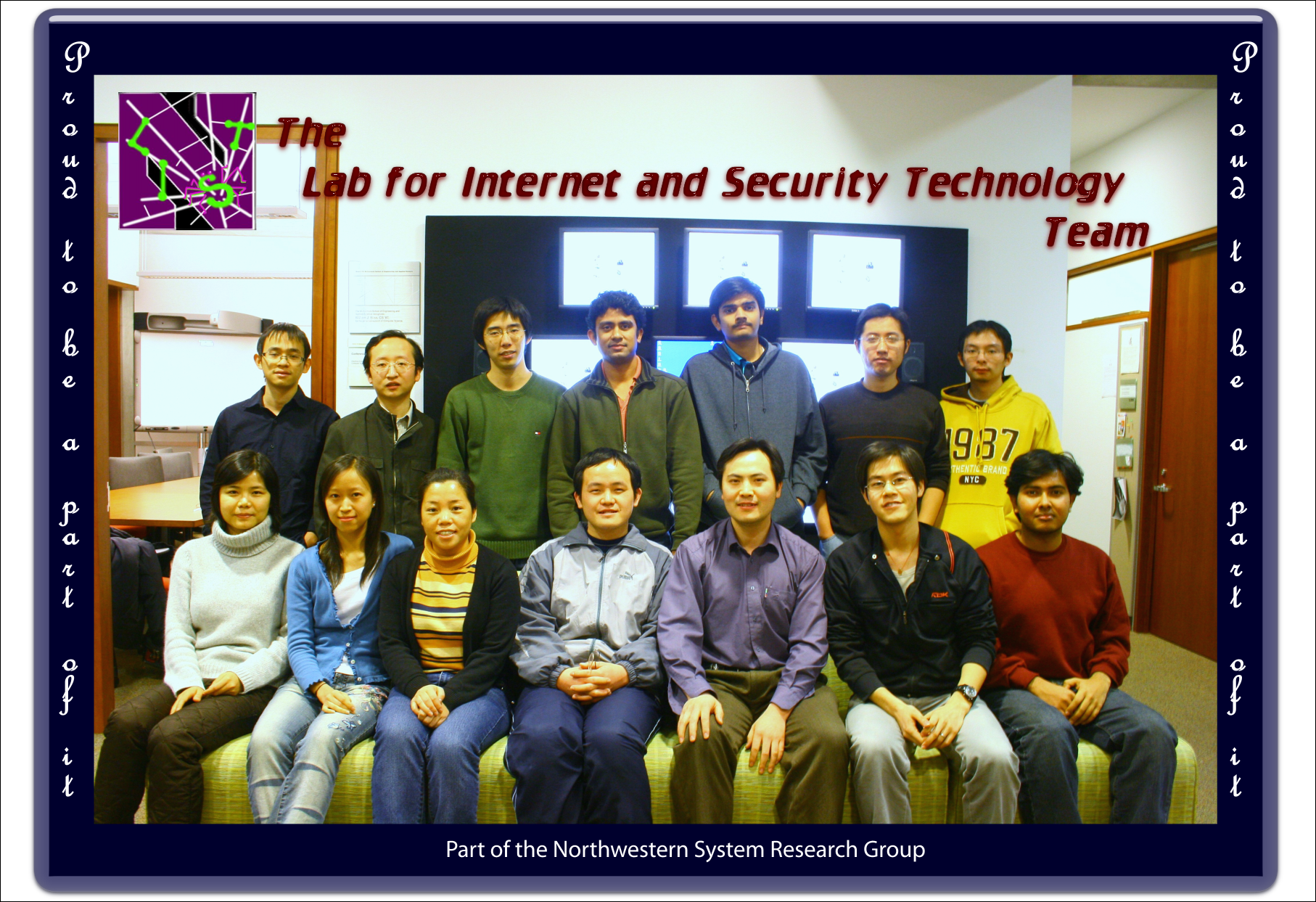
The LIST team as of
December 2007.
The theme of our research is to monitor, diagnose, and secure the Internet, for both core and
peripheral networks such as wireless networks. The Internet has become the most important communication
infrastructure of the society. However, as the Internet has evolved it has become increasingly
complex and vulnerable. To address these problems, over the past few years I have increasingly focused on Internet Security problems, in particular, intrusion detection and
those arising in emerging and challenging Internet
environments, such as Web 2.0, smartphones, online social networks, and very high speed networks.
At the same time, I continue working on design, architecture and management of the next generation
networks, such as data center networks.
Our
research methodology is the combination of theory, synthetic/real trace driven
simulation, and real-world implementation and deployment. We draw from diverse
fields of applied mathematics, such as combinatorial
algorithms, linear algebra and statistical learning as needed to better
understand the design space structure. To get access to the real Internet
measurement (often proprietary), we have been actively collaborating with
researchers from various places, such as AT&T
Labs, Motorola Labs, Yahoo!, Keynote,
Microsoft Research, Fermi National Labs, National Laboratory for Applied Network Research
(NLANR), and the Internet Storm Center
of the SANS (SysAdmin, Audit, Network, Security)
Institute.